 Hey, guys, I just got my Spotify Wrapped! Let’s check out what it has to say about my musical tastes this year:
Hey, guys, I just got my Spotify Wrapped! Let’s check out what it has to say about my musical tastes this year:
Daniel Ek, CEO of Spotify, is a true monster. The first and most obvious way this is true is that Spotify massively underpays musicians, and thanks to Spotify and streaming at large becoming some of the most popular ways to experience music, this has made it much harder for the artists who create the music you love to make a living. Spotify helps to platform Joe Rogan, who (among other atrocious acts) helped to spread misinformation on the COVID-19 pandemic which we are still suffering from now. Spotify’s algorithms tend to cause severe problems for certain artists’ discovery - which, to be fair, is not a Spotify-exclusive issue, but that doesn’t mean they’re immune from criticism on this point. Spotify continues to be a major booster of AI-generated music (up to and recently including a AI knockoff of the band with everyyone's favorite name, King Gizzard and the Lizard Wizard, after they pulled their music from the platform). Recently, Daniel Ek invested $600 million into Helsing, a German weapons company that develops drones and AI software for them (in addition to other products designed exclusively for the brutal oppression of human beings). As of this writing, Spotify was airing ads for ICE recruitment.
Daniel Ek and Spotify, along with all other streaming services and their owners, seek to reduce art to a slurry and make artists into slaves - and in his case for sure (and definitely some others’), he is turning their stolen wages directly into human misery (even beyond the wage theft). He, personally, is an evil man, and by choice.
Huh. That's not what I would have expected to read in a Spotify Wrapped. I wonder if this is actually just some sort of stupid gimmick to kick off a rambling article wherein I show off more of my records.
Needless to say, I stopped using Spotify years ago, back when Joe Rogan was advertising horse paste and doing other agent-of-chaos stuff. I don’t have a "Spotify Wrapped" this year because I do not use the service and have not in several years, not even when I’m too lazy to run Winamp. At this point, I’m not convinced you can while considering yourself to be a "good person" still. Certainly you can’t subscribe to Spotify Premium and still be a “good person.” If you are currently giving money to Spotify, I’d like to suggest you take up red gloves as a fashion statement, because the blood on your hands ain’t gonna wash out, not in a million years. You probably would do better by pirating all the music you listen to. I’m almost convinced the artists earn more from you torrenting their albums than from listening to them on Spotify; usually, at least one pirate had to buy an album for those. In all likelihood, too, your phone has some storage space on it and you can download VLC to it. Now not only have you divested from Spotify, but you’ve gotten some control back for your playlisting. You’ve probably also unlocked higher quality options, too, because I believe Spotify’s music is roughly the equivalent of 64kbps for non-paying users, and a comparatively pathetic 192kbps for those who do pony up; that's decent quality, but it's really only "high quality" if you have only ever heard music on those dictation microcassettes before.
Here’s what I did instead of giving my money to Daniel Ek: I bought records and CDs. Sure, it was more expensive, but I actually own it, and I think any of these that I bought new (and admittedly, a few were not!) supports the artists more than Spotify ever would.
Now, I’m not going to come in here and say that the owners of the services I used to buy these from are good people. At least a few of these were bought on Amazon. I’m sure eBay is not using its money for the best of purposes, either. Discogs is probably pretty alright, though. But what I am saying is that, not only do I actually own the music I paid for, but I think if you want to total it up, the money that these fatcats extracted from me is probably still doing less evil than if I were a Spotify user, and by not having a Spotify Wrapped, I’m not doing free advertising for them.
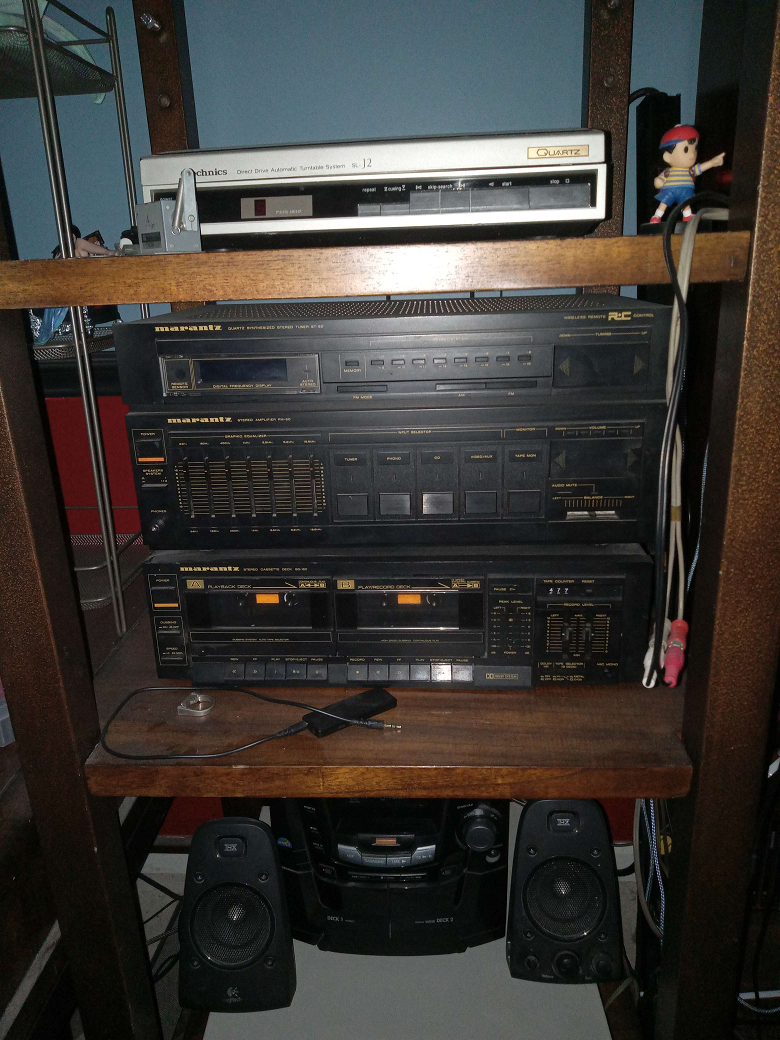
Now, I recognize that these options are not for everyone. As in, "not everyone can participate in them." Obviously, for a start, this isn't nearly as affordable as paying for a streaming service, and while having a curated collection helps me savor things a little better, I'm in a comfortable and secure position financially at the moment to be able to afford this and not everyone is afforded such a luxury. CDs require a bit of space to store, and either a computer with an optical drive (becoming less common as time goes) or another device, such as a portable CD player, certain game consoles, a DVD player, perhaps even a dedicated plug-in CD player. Compared to a modern smartphone with, say, a 64GB microSD card1, CDs don’t look so portable as they seemed back when the first Discman became available. And lord have mercy upon you if you’re a vinyl-record collector. Not only do LPs have a huge surface area relative to their total volume (meaning you need special storage solutions), you also need a record player for them, and for many of them that means a phono preamp or an amplifier, plus dedicated speakers. Do you have any idea how much space that takes up?!
Here, I’ll show you a photo and you can hash it out! (Oh god my shelves are so dusty...)
So for sure this is not going to be an easy task for everyone. For example, unhoused people would not be able to do what I’m doing, and they deserve to be able to listen to music too. If you for various reasons are actually unable to do anything but streaming, that is understandable. Don’t let me get so holier-than-thou that I start shitting on people who are trapped or tell them that they should simply stop listening to music. Imagine that concept. It would be like telling someone they weren’t allowed to breathe.
But setting aside exceptions of this sort, maybe you should stop using Spotify. Find other streaming services at least - and that is advice I can give to people for whom collecting physical media is not a practical pastime.
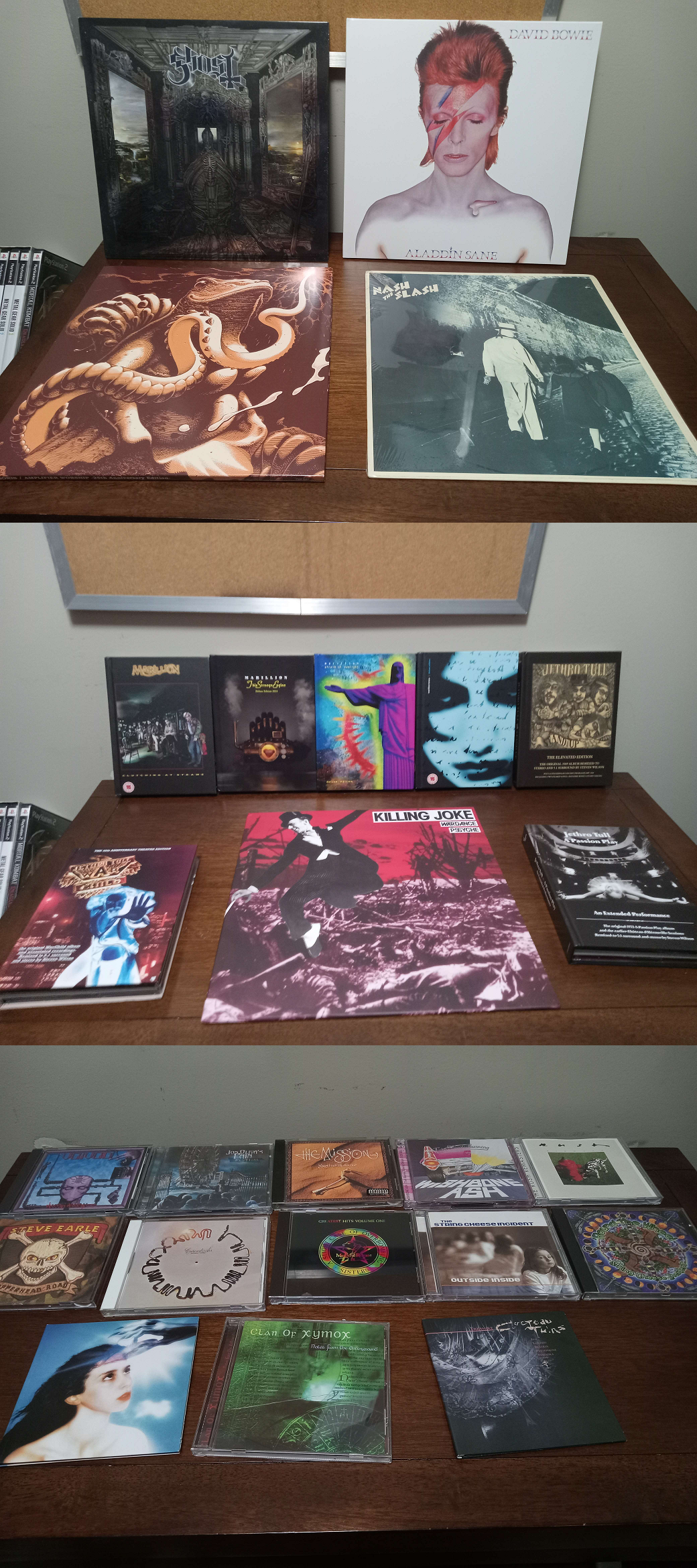
I know you still want to hear about my musical excursions this year, so instead, I’ll go over the new additions to my shelves for this year. In roughly the order that I picked these up:
I saw the updated cover art for the new vinyl release and knew I had to have it. Since I had just recently sold off some old collectibles I no longer wanted, I made it happen. Love that thing. The original is a photo of some weird ceramic-looking tchotchke that looks like, well, a frog in a dress. So someone made this really badass-looking picture of it. This would make a helluva conversation piece if I ever had guests. If I ever live somewhere where having guests would be feasible, though, I still wouldn’t.
For the unprepared, Amplifier Worship is a bracing and difficult listen - an hour-plus of snarling, droney sludge-metal, a type of music that feels a bit like being trapped in quicksand. This style of music is niche for a good reason; I can't imagine there being a large amount of audience specifically attuned to this and it can even be a bit uncomfortable, especially if you're sitting there just waiting, like on the tail end of "Huge." It becomes easy to lose track of time listening to something like this, so those eight minutes and change can feel like you're still maybe only three minutes in. Don't listen to this if you've got somewhere to be.
Nevertheless, there's some pretty interesting musical ideas going on here that show that Boris are a very forward-thinking group in this arena. This probably, for some folks, weakens the atmosphere a little, but that in no way makes the music weaker. But I still think this sounds really cool, and following along with what's going on with tracks like "Ganbou-Ki" is an interesting experience. The vocals sound like they're feelin' sick, though. Get that guy some medicine!
(Also, I have this on vinyl, but I listened to it via the magic of "finding it on YouTube". The 2LP set is in a slightly different order from the original CD, because it has to be due to the sides of LP records needing to be about 20 minutes each at most.)
What do you mean I picked this up this year?!
I’d been trying to collect the early Mission albums for a minute, and finding a copy of this one for a price that didn’t suck was not easy. I guess it was not well-printed or maybe did not sell in too great a number long-term. Grains of Sand is an album of extras from the Carved In Sand album, and it’s probably not very essential. However, it does include the wonderful “Hands Across the Ocean,” which stands a real chance of being the band’s best song. But you could probably pick that up on a compilation if you’re not a hardcore fan.
My dad loves Steve Earle, and I’ve kinda come to love him too. How the fuck does he not have a copy of this on CD? (Probably because he has an LP copy instead.) So I bought one for myself because I’m stingy, but it’s not like I wouldn’t loan it to him if he wanted it.
Copperhead Road is a bit country and a bit rock-and-roll, and while I'm no great fan of the back half (primarily some fairly by-numbers lighter fare), the front side leans harder on that more rock-oriented side with vicious social critique. Three easy winners to be found here: "The Devil's Right Hand" is a re-recording of an earlier B-side by the guy (possibly inspired by Waylon Jennings covering it in 1986), describing a man whose life is absolutely ruined by how much of it he spends around guns. "Snake Oil" is an excellent character sketch of Ronald Reagan as a con artist (which is if anything too polite to him). And of course, the title track, an excellent number that deals with the war on drugs just as ably as it does war and its relation to the poor. Steve's left lean making him a pariah in Nashville is just proof that the country music industry should burn to the fucking ground.
Jethro Tull had a big string, following the success of Aqualung, of several very ambitious albums. Ian Anderson may not have liked that Aqualung was regarded as a concept album, but he sure had the ambition to do that and more. Following two albums that werre effectively only a single song long (both of which went to #1 on the Billboard 200 back in the day - my, how tastes have changed), War Child at least was formed of a more... normally-structured set of songs, ten tracks averaging about four minutes a pop. However, this was intended as a soundtrack for a film project, and there were a crapload of outtakes. I think this book is comprehensive as far as an album release goes, i.e. you have everything from previous editions of the album on here (which is a big bother of mine; these big books should at bare minimum supplant the older CDs!)
Although it could never be accused of being Tull's best album, War Child is pretty likable. You're probably aware of the rather silly single "Bungle in the Jungle," but I think the actual winner on this album is "Sealion," a track that moves at an absolutely breakneck pace that really makes you go, "wow, I bet they don't play that one in concert anymore!" A lot of the music that did make it to the album ends up feeling exactly as much like soundtrack music as you'd expect given its origin; it's understandable that the two songs that were chosen as singles were, uh, chosen as singles - because outside of listening to the whole album at once (and aside from "Sealion," which probably couldn't easily make it on the radio), most of this is just a bit skippable.
For the curious with the 2002 edition: to my knowledge, yes, all the bonus tracks of that version are on the Theatre Edition. The only possible exception is that maybe, maybe the version of "Warchild Waltz" (called "Waltz of the Angels" on the later edition) is different. I forget and I'm too lazy to check.
For those who are curious about Ian Anderson's ambition outside music, he apparently tried to put together a TV special out of Too Old to Rock 'n' Roll; Too Young to Die! in 1976. That book-bound edition is based exclusively on that version, weirdly enough (but I suppose that's of a certain historical interest).
Although it’s part of the Canadian prog-thrash quartet’s brief brush with mainstream relevance (which probably infuriate the most extreme of metalheads who likely don’t even listen to Voivod because they’re not hardcore enough), Nothingface is an album that shows Voivod still ably flexing their creative muscle. They just do it with lessened BPMs here than on Killing Technology and earlier, making this a much easier onboarding point.
If any song off of this became well-known, it’s the Pink Floyd cover - “Astronomy Domine,” probably a too-obvious choice for a sci-fi themed group like Voivod, making it kind of a pity that this seems to be as close to a “hit” as the group ever had down here. But the entire album is worth your time, a jagged and nervy experience, especially with jittery numbers like the title track and speedy, slightly disorienting tracks like “The Unknown Knows.” I think prog-metal has a certain reputation for just being about grossly over-the-top complexity, but here’s a group leveraging their profound technical skill to paint a picture instead, create a setting - a sci-fi horror vision, probably inspired by Michel Langevin’s brush with death in a car crash when he was younger. I need to get his artbook sometime! I know he mentioned a car crash in an interview.
The String Cheese Incident were part of the 90s jam band boom, and their main trick early on was a bluegrass influence... which no doubt means that the first two albums are very much an acquired taste. But the main thing I remember of 'round the Wheel is how laid-back a lot of it is. Nevertheless, this is also a time where you get to see a band that was already pretty open to trying a few new things starting to open up its sound a bit. Throw in a few bigger tracks where the band can stretch out - "Galactic," "MLT," the title track - and you have an excellent proving ground for the band, as if they actually needed such a thing.
One thing I really like about the group, other than their great flexibility, is that they love to put a lot of variety particularly into percussion. On this album, they step that variety up a lot - I think they've even got some more stuff going on here than on Outside Inside, their next album. Listen closely to the amount of interesting African percussion; it adds a good bit of texture to the sound. It helps make clear that the band stands out a little bit from the crowd, when I think otherwise they might blend into the woodwork for people who aren't jam-band-heads.
Probably far easier for the newcomer to digest because the group leans more heavily into the rock-music parts of their sound, and I think most people who hear about a new jam band are expecting something a little more like that. And yet their sound hasn't narrowed at all - if anything it's just getting wider with every album. Replete with chunks of funk, calypso, bluegrass, reggae, Outside Inside shows the band proving their versatility - a vital thing for them to bring to the stage, ad of course, because they're a jam band, I think most people will assume them to be at their best on the stage. But their studio records are still pretty incredible. I think one of their advantages on stage tends to be that they are very good at "going wide" sonically. This band could take on anything.
While you should listen to everything on this album if you are remotely interested in a jam-friendly rock group, my two clearest picks are "Joyful Sound" if you want something that feels like a fairly ordinary single, and the gigantic "Rollover," a ten-minute colossus that hops through several genres, gettiing faster and slower in various places, and just generally being a multi-part monster. Out of the many big, jam-friendly tracks on SCI albums, this one's my favorite.
These Marillion deluxe editions do something that pisses me off a little, but this one doesn’t have that problem. To explain, we need to discuss the history of Marillion remasters.
Back in the 90s, the band started releasing “24-bit remaster” sets of their eight major-label-era albums. In some instances, I have to think it was a little soon to be doing this. Afraid of Sunlight came out in 1995, and its remaster dropped in 1999. Incredibly silly. These were two-disc sets that put the main album on one disc, and some bonus tracks (of various kinds - single B-sides, remixes, alternate takes, etc.). You can likely guess where this is going: typically, these deluxe editions lack these bonuses, replacing them with concerts from the era (though not always from the era). Those are nice to have, but it means these do not supplant the old remasters and cannot be deemed "definitive" as I would really want them to be if I was spending forty bucks on a remaster of an album on CD!
The thing is, the set of 24-bit double-disc remasters cuts off right before This Strange Engine. So this set is free of these issues.
Don’t get me wrong. This still isn’t definitive. This album had a remix album attached to it called Tales from the Engine Room and a couple of other bonus tracks from various releases. None of which are here. But they did include the "Big Beat Version" of "Memory of Water"- which usually is a fairly spare acoustic tune, but which has, through the magic of arrangement choices, been rendered as... this. It’s like a completely different song... and completely different from the version on Tales from the Engine Room, to boot, which is also an album of electronic dance music remixes. It’s a wild choice.
Anyway, I saw these guys in concert some years back. I still remember Steve Hogarth talking about the requests for songs he gets and jokingly suggesting someone told him "My daughter is named "This Strange Engine."" Gleefully absurd. I wish these guys were actually popular with people who weren't just prog dorks. ("Prog dorks" being affectionate nomenclature which also describes me.)
An EP. I bought this because I wanted something with original B-side "Pssyche" on it, an absolute rager of a track that somehow did not end up on the main album at the time due to what I’m led to assume is one of Jaz Coleman’s moments ("moments") of inscrutability. I originally ordered compilation The Unperverted Pantomime for this purpose, but it failed to arrive and I badgered Amazon enough to get a refund for that and the other thing that was presumed lost (a Stylophone, which I’m significantly sadder about; oh well, I bought Treasure and Imaginal Disk with the refund money, so it’s probably fine).
This version has a few bonus tracks and is on some nice red-and-black vinyl that looks cool as fuck. It also comes with some neat extras. Due to the expanded nature, the song is on side A along with album track “Wardance” (which is pretty good, but for first-album Killing Joke, I prefer "Requiem"). Great, but I don’t have a ton of need for the bonus tracks, really. Still, nice to see this back in circulation. RIP Geordie Walker!
Folks, we’ve found the forte.
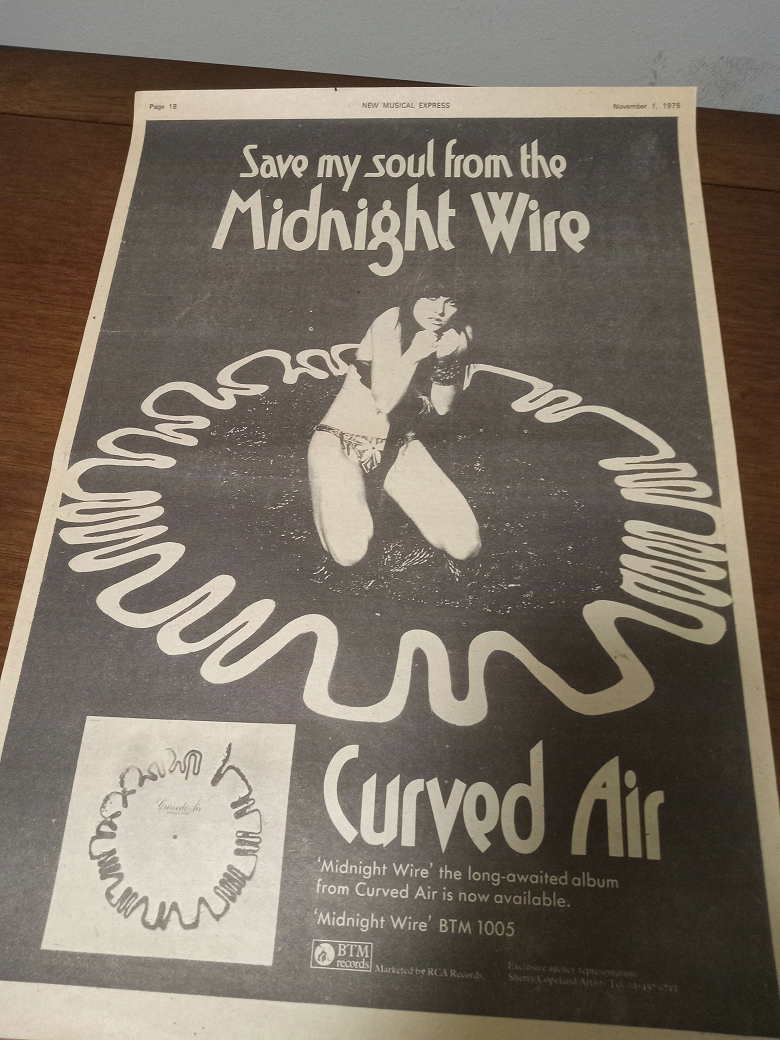
This criticism is going to sound very, very bad because Curved Air were one of the few female-fronted prog bands at the time, but Curved Air were almost undeniably a gimmick band. The group doesn't lack for talent relative to the whole of rock music - they're certainly above average even if you look only at the folks mostly known for their stint with the group - but it seems like that wasn't what they were trying to parlay into record sales. After all, Curved Air are primarily known nowadays for their first album Airconditioning having one of the first rock picture discs in its LP incarnation (I have one of the newer issues of the picture disc on LP. It looks very good while spinning, but the album is very mediocre and I really only think the song "Hide and Seek" on side 2 is worthwhile.) and for having a very attractive female lead singer - and they definitely leaned on Sonja Kristina's sex appeal in at least this advertisement for this very album! (It kinda looks like a poster for an old horror movie where they capture a girl and are about to make a sacrifice out of her. Pity I sold my camcorder a while back or this'd be in the background of any Halloween-themed video sets I make...)
Nevertheless, considering this group has had some talented musicians cross through their ranks (Eddie Jobson plays on one of their albums (at the incredibly young age of 16)!), higher-complexity art rock never seemed to be their forte. I can’t tell if their reach exceeded their grasp or if they just were too lacking in ideas, but I think it's actually the latter. A lot of their attempts at more outlandish things do feel a bit basic at times. I’d be hard-pressed to truly call them bad (as much as the masters on some of their albums would try to get me to say otherwise), but this album feels more up their alley - less needlessly-overcomplicated from a musical perspective and more focused on Sonja Kristina's voice, which has always been the defining element of their music, the part that makes it stand out. Plus, poppier prog-lite is not at all a genre I dislike.
Obviously, I’ve been listening to this one for years at this point. It’s a fantastic album. This is mostly because I bought a copy on LP with money I got back from a refund from something I bought on Amazon that didn't get delivered. This is, in fact, so mainstream that I’m not gonna give it much of a review.
Holy crap I love "Panic in Detroit." Bowie even re-recorded it around 1979! That version isn’t as good. Get this album for the title track and "Panic in Detroit" if nothing else.
I think I discovered this one in high school when I was just starting to get into more post-punk stuff... er, such that you could even call this that, since it's so far removed from that. Why did I wait nearly twenty years to buy a copy? No idea. If anything it’s because I was very much in a position of listening to only certain songs at any given time and this isn’t an album that is very good for that sort of thing. Treasure is kind of a vibe, an album you have to be in a certain mood for. Beautiful, evocative and otherworldly thanks in no small part to Elizabeth Fraser's vocals-as-instrument (seriously don't try to make sense of the lyrics) producing such heavenly soaring sounds. Actually, if it weren't for the drum machine sound being exactly what you would expect out of a drum machine from 1984, a lot of this might be wonderful to fall asleep to. You also really lose track of time with some of these; a three and a half minute song feels both like half that and several times more. Of course, that drum machine is so weird for this, but tends to contribute more to the more nervous-sounding songs like "Persephone," which feels like it's slightly touched by industrial nightmares, and feeling like less comfortable of a fit on something like "Pandora (For Cindy)," which is so much lighter and more pleasant. Though, it's a technical limitation of the era, what can I really say. I still really like it!
Beautiful album cover, though. I should have bought the LP edition of this, not the CD...
This one's dedicated to all you freaks who don't think it's a bad thing when a song changes into several others across its runtime, but still wish those lengths were digestible.
I wasn’t sure what to expect out of this album from the cover art and it being a pop record, but ooooooh my god this is extremely good. I mean, I appreciate in general the idea of "what if vaporwave was a real genre," and Mag Bay also seem to have a strong appreciation for prog rock in amongst all their influences, so the results are a gripping array of some of the catchiest sounds from the 80s and 90s, written and performed by very skilled songwriters and musicians.
For this genre, it is perhaps too easy to simply name-check the singles as being really good - they are, I mean, and "Death & Romance" is one of the best songs of 2024, but of course they are. Pop music doesn't have a great reputation for being very essential past the singles, though. So, "She Looked Like Me!" is another great song to grab that unfolds over time into something far more intense than its beginnings would suggest, a song about self-confidence whose early sections with music box sounds do not reflect the final product. "Angel on a Satellite" does end where it begins, but it goes on a hell of a journey there and back again. Any song you pick, be prepared to go on a sonic excursion. A master stroke top to bottom, and I love any piece of media that can ably combine the future and the past in a coherent way.
A return to form after Impera was mostly mid at best. Pretty solid all around with only a few songs being “too goofy” - “Missilia Amori” being the most notable offender (look, it wouldn’t be the first time our beloved evil popes have sung about fucking, but the phrase "love rockets" is too stupid, and putting it in Latin in the song title is the first and only known violation in history of the rule that anything said in Latin sounds smarter), but once you set those aside, you’ll find an album of quite solid late-80s-style pop-metal. And I’m glad they’re leaning into the 80s style now, as much as I prefer the obvious Blue Oyster Cult-isms of the earlier records. It gives them some variety, and allows them to lean into some of the more dramatic stuff a little more easily, especially as the story of Ghost changes from merely being "what if the 70s metal bands were what the Evangelicals were claiming they were" into an actual story with characters and the Papa Emeritus' interpersonal relationships. It gave us "Lachryma," which I think has to be my favorite song of the year ("Subways of Your Mind" doesn’t count because it came out in 1985!) - but there was stiff competition!
Unfortunately, my copy did originally come from Target. I bought it on eBay, but that doesn't change the fact that it was someone reselling a new copy that must have originally come from Target. Target has decided that their mercenary nature would be better served by leaning hard into right-wing tastes, taking away most of their rainbow capitalism and, far worse, donating huge amounts of money to Donald Trump's 2024 presidential campaign. I suppose at least my money didn't go directly to Target, but it's still not the most ethically-sourced object. However, it is a lovely shade of purple. While putting it away, I just noticed for the first time that it's marginally translucent, too!
How on earth was this my first copy of Jethro Tull’s second album Stand Up? I’d heard it for years and always thought it was one of their best. I think maybe I just was less attached to the less-textured sound of Stand Up than their more prog-oriented releases (or even their stuff from the 80s - yes, even Rock Island and Under Wraps!), but that doesn’t change the fact that this features not only some masterful playing, but some top-notch songwriting on full display. Most bands don’t arrive as fully formed as Tull did, but holy crap, they know what they’re about and got right the heck to it in a hurry. They sound so much more sure of themselves than they did on their debut, perhaps because they knew that ultimately being just another British blues-rock group was truly not their destiny, and with Ian Anderson and his wide musical palette as the only songwriter here, they were incredibly focused.
This isn't the prog rock that we would know them for playing on later albums, sure, but really, a lot of that is built more or less out of Anderson being frustrated by Aqualung being seen as more than he meant it to be, then realizing his own ambitions after he accidentally made one of the band's best albums in the middle of a stunt that, in retrospect, is probably kind of stupid. The throughline from here to Aqualung really doesn't need that much deviation! Maybe the pieces need to be arranged a bit differently. There's a little bit of jazziness here and there, maybe most prominently in the reworking of Bach's "Bourrée in E minor" for flute. They break out a mandolin for "Fat Man," and a balalaika for "Jeffery Goes to Leicester Square." I'm pretty sure the winner here, though, is "Nothig is Easy," a jazzy number where they go all in on their harder rock interests. Plenty of room for stretching out, too!
But of course, we have to determine how well this does on supplanting the previous version, and the answer is "mostly good, but for some reason bonus tracks "Sweet Dream" and "17" are on the collectors' edition of Benefit." So, that'll do, I guess.
So, I only really learned about this guy a year ago, but he’s a certified, bona fide weird dude. Er, was all that, he tragically passed on some years ago. Nash the Slash, offstage name Jeffrey Plewman, was the first lead singer of Canadian prog-pop-rock band FM (who later included Ben Mink in his first major musical project!), where he led the group through their first album Black Noise, which proudly boasted of using no guitar (like the inverse of Queen’s earliest albums, which all boasted of using no synthesizers), until he parted ways with them and embarked on a solo career. Did I mention he performed in a suit and top hat and with bandages almost completely covering his face, all painted over with phosphorescent paint? He was a striking sight, and he plied his aesthetic in some fun ways; Children of the Night contains one of the closest things he had to a hit, a cover of “Dead Man’s Curve” (a 60s car-crash song by Jan and Dean), for which he shot a video featuring him as the driver of each of two fairly period-appropriate cars in a street race, mimicking the song’s premise. He’s too old to be either of the protagonists and dressing in a way that doesn’t fit at all, so the juxtaposition is an interesting one.
Children of the Night has a decent amount of covers, including a version of the Rolling Stones’ classic "19th Nervous Breakdown," whose different instrumentation and arrangement make the whole affair feel more moody and in general make me realize that the person being described in the song sounds very much like they’re autistic and gives the song more of a vibe of a cry of frustration by or on behalf of the person who’s having a very serious problem with their mental health. My favorite song on here, though, is probably "In a Glass Eye," though - yet another original that absolutely tears. Seriously, those synths have a way of sounding like shredding guitars at some point. I wonder if some group out there that does kind of an Iron Maiden-y thing has ever covered this one.
Get it? Like musical notes, and because they’re not a very well-known group!
A while back, I think maybe last year, YouTube’s algorithm fed me a song from this album. It’s probably one of the better things the YouTube algorithm has given me. I’d been interested in Xymox for a while but was not sure where to start, so thankfully the machine chose for me and for once seems to have chosen right! I set about tracking down a copy of this album as fast as I could. It, needless to say, did not go well. Notes from the Underground has been out of print for a while, with the exception of a two-LP reissue in Germany, which, while I’d love a copy, is grossly expensive and of course is now even more so thanks to our pedophile-in-chief.
So, goth music, right? It's a pretty wide genre, actually! I'm far more familiar with the type that is mostly post-punk-influenced, like the Cure and Siouxsie, and their descendents of the Sisters of Mercy breed. I guess I also know a little darkwave here and there. But - at least by this point, if not at their outset - Clan of Xymox was making a lot of music that sounded like it could probably have fit in at a goth club. There is a lot of electro in this album's blood. I mean, there's a bit of that in the little bit that I've heard from them otherwise (a few songs from Creatures, so I think that left me feeling slightly out of my depth, but it's fully pleasant, although a bit gloomy. I love how much more intense "The Bitter Sweet" gets halfway through the song. "Something Wrong" remains an absolute winner, though, a bitter rebuke of a horrible former partner with simply immaculate vibes... of how much the whole situation sucks. It sounds so miserable! Good job, guys. I really need to listen to more of their older albums.
So, I've never really been able to get into this album very much compared to the technically similar Thick as a Brick - Tull's other literal one-song album. I mean, sure, there's quite a lot of pretty good music on here, but I think part of it is that it's spread out much wider than on Thick as a Brick (which places most of its best music on the first side, with the second side being a tad weaker). This is a problem because the only other copy of A Passion Play I ever had was the early-2000s CD, where all the tracks are relegated to being single tracks per record side. The first disc corrects this. This helps me out a lot for when I don't feel like sitting around to listen to a whole album and just want tracks for playlist purposes. "Flight from Lucifer" and "Magus Perde" my beloveds...
Thank goodness the bonus features are great! Compared to that other CD, which only gave you a video clip, you have the entirety of the extremely good and very historically-interesting Château d'Hérouville sessions (a.k.a. the rejected original version of the album from sessions that went massively sideways). There's actually more material here than there was on the original release on Nightcap. Between this and the... what I'll call "improved usability," this is a must for anyone who likes the album, and probably most Tull fans or just prog-rock fans besides.
Having now collected all most of the Jethro Tull Deluxe Editions (I’m only missing the live album, which is a live album; and Living in the Past, which I don’t think had any extra material), I set my sights on rounding out my collection of Marillion deluxe editions. I ordered the last three I was missing having finally seen them at acceptable prices, but Clutching at Straws briefly went a bit AWOL on me, which had me worried. I got it for about $40, most copies I'd seen had been in more of the... $100 range. Because it's been out of print for a minute.
Afraid of Sunlight is a very good album, probably my second favorite of what I’d call the "early Steve Hogarth era" (because it was their fourth album with singer Steve Hogarth), behind only Seasons End - a dense rumination on fame and being known in the modern world, inspired by O.J. Simpson, who was on trial at the time. And yet my favorite song is probably the one that starts off as a twisted Beach Boys pastiche and ends in erotic(?) cannibalism. If you want something a bit less goofy, my immediate recommendation is "King" - inspired by the likes of Elvis Presley and Kurt Cobain, whose fame ultimately destroyed them. But there's a ton of neat little bits to like throughout, such as the aforementioned Beach Boys pastiche "Cannibal Surf Babe" (someone call up Charles Band, I've got a great idea that will sadly result in the most fame in this country this band has ever gotten other than for "Kayleigh"!) and the Phil Spector homage "Beyond You," which is mixed in mono, just to show how far they were willing to go with the concept! Oh, yeah, and "Out of This World," inspired by former land- and water-speed record holder Donald Campbell, inspired someone to look for the wreckage from when Campbell died, and the guy found it! I mean, how cool is that?
Big stupid complaint, though: I miss the design of the front cover of the album's original release on the front. The Jesus one looks so much more garish (mostly due to color palette). On the other hand, there's a much more severe issue, which is that many of the bonus tracks from older versions (some of which I remember being very good!) are only on the Blu-ray audio discs. I know record companies don't like you ripping CDs and never have, but this feels like such a massive fuck-you to people like me who like to do that at all. I'd almost rather they weren't there at all!
One of my hottest Marillion takes, other than the fact that I would put Brave somewhere in the middle of my scale of quality, is that Brave cannot work on CD anyway. Not even "doesn't work as well on CD," cannot work on CD. Only the LP version gives the proper experience. Sadly, I don't have the album on LP, because a copy of such is monstrously expensive. See, the original LP versions of Brave had a feature I’ve literally only ever seen on a Monty Python album. The last side is very short, but there are effectively two back sides - one representing a "good ending" to the story, and the other a "bad ending" - which is accomplished by having two grooves on the one side. You don't entirely know what you'll get when you drop the needle. That's a special experience. I can confirm that the mystery made Monty Python’s Matching Tie and Handkerchief record significantly better... because I don't remember that album being super-great otherwise.
Unfortunately, Brave Deluxe does not include the late 90s bonus tracks, not even the "side E" tracks. So as much as this sounds quite good for what it is musically (Brave is an early-alt-rock-inspired prog-rock opera - let the fact that Radiohead found it to be a massive inspiration tell you what you need to know), and as neat as the bonus concerts are... it still annoys me more than a little. Oh well. I love "Living with the Big Lie," and several songs not quite as much as "Living with the Big Lie."
My collection of these Marillion deluxe editions is now complete, at least until they decide to do more of them...
My overall commentary on these applies just as much to the others. As a re-release, all but two of these so far stumble a little in the "supplanting prior releases" department, those being This Strange Engine and Misplaced Childhood. This does better than most, but not perfect - and seriously, is it too much to ask for there to at least be some sort of comprehensive release? I acknowledge that the amount of over-the-top completionists of my caliber for any band is nanoscopic, but even so...
Clutching at Straws is an alright album, but it is my least-favorite Marillion album with original lead singer Fish. Obviously, you shouldn't take this to mean the album is "bad," but I think musically the group sounds a little tired here - no longer as vital as on Script and with somewhat less-brilliant songwriting than Misplaced Childhood. It's a bit of a pity because, as the album title clearly references, a lot of this album mirrors the struggles that Fish was going through in his personal life; failing relationships, struggling on the road, and at war with the bottle (among other substance-abuse issues). It's honest and shockingly raw when measured up to the stereotypes of prog rock. You can understand why Fish went on a successful-by-prog-standards (i.e. lotta albums and beloved by prog fans) solo career after this. But, um, that's just kinda been Marillion's bag for the entirety of the Fish era. Fish wrote personal lyrics that were just as often direct as they were full of oblique imagery, seeming to very strongly take up the lessons of punk-rock; I suppose being a working-class Scotsman who hung out with a lot of socialists will do that for you. Most of the first four Marillion albums are highly personal lyrically, all have at least one song about a relationship crumbling, and most have a song about substance abuse. Musically, the band has been mostly in the same lane of punchy, dynamic prog-rock since the beginning, too. It means that the album doesn't do a lot to stand out from its predecessors.
Look, as much as I love the classic prog sound, the genre is called progressive rock. Which means it ought to progress. It's why even the worst Hogarth-era albums are more interesting to me than this; they're different. Hogarth-era Marillion rarely repeats itself wholesale. In short, I got this one last for more reasons than just the fact that the cheapest copy I could find for a while still broke a Benjamin.
How did I not own a copy of this already? Easily one of the most pedestrian things on this list. But Signals is probably one of the most underrated Rush albums of all. Er, wait, I guess Grace Under Pressure is literally right there, too.
I think public opinion of Rush falls off a bit with the dawn of their Synthesizer Era, is that right still? Well, if you can stomach the increasing amount of synths (which, is this even still a problem in 2025 as a thing in music aside from the most grognard-ass rockist boors?), Signals has plenty of great songs. You of course know the single "Subdivisions" (I think "New World Man" is kind of underwhelming), but the entire first side is great - especially up-tempo rocker "The Analog Kid," which ably combines many parts into a song that just feels huge and deftly illustrates the nightmare of going from a slow rural life into the hustle and bustle of the city for the first time. Everything after its second chorus is probably some of the best stuff that Rush has ever put out. Side 2 opens with "The Weapon," a catchy-as-hell piece that nevertheless still features a little bit of complexity carefully interwoven so you might miss it. Now, granted, I think the album drops off a bit after that point, but it’s hard not to love the rest of it.
I, for some reason, have never bought or even listened to a full Sisters of Mercy album. Maybe it’s just that Andrew Eldritch seems like a bit of a dick. I mean, even their best song is a diss at ex-bandmate Wayne Hussey's lyricism. He's talented, but damn is he hard to like. But in all truth, it's probably just from laziness. I have so much shit I need to get around to listening to, and usually I just listen to the same like eight songs or something. (That number is a severe exaggeration. It's fewer more than that.) But this disc contains most of my favorite songs I've heard by this group, so that'll do. On the other hand, with two of those being "Temple of Love (1992 Version)" and "This Corrosion," that takes up a quarter of the CD already. Nobody's really going to accuse a compilatio of being the best choice for any artist, though, so whatever, I'm overthinking this.
Putting this one in the list of "I'm not sure why this stuck out to me." Wishbone Ash is one of those bands that's generally considered to be very important that I've nevertheless never really listened to very much. They're alright, I guess. But I think I was suddenly reminded that I heard the song "Engine Overheat" one time and thought it was okay. I listened to it again recently and noticed some neat drumming patterns in the chorus (I mean, they're ones I've heard before in other songs, but still), adding a bit of texture. And yeah, that's about what I can say about this album. If you just listen to it passively, you'll get some basic arena-rock with twin guitars, which is not impressive for an album from 1981. If you listen closer, you'll notice some details that still won't make the album much better than a three-and-a-half out of five. This ain't the group at their prime. But hey, a CD of this was actually available new. Shocking.
(Not to be confused with “John Oliver’s Pain,” which is probably the HBO exec breathing down his neck after every episode of Last Week Tonight comes out when he says something about how demonic right-wingers are.)
Jon Oliva was a member of Savatage, a Florida-based metal group from the 80s and 90s who were a big influence on power metal, and also a member of Trans-Siberian Orchestra, the christmas-metal group you are almost certainly aware of because it’s such a strange thing conceptually. Supposedly Savatage is back together again and may release an album next year, which I’m kinda hype for. Jon kept himself sharp after the band broke up in the early 00s with this project, which released a very few albums. Of them, I’ve only heard Festival, and I’m pretty sure this is the most available album physically of theirs. I got this for about $20 delivered; any other albums I encountered by JOP were way more.
Comparing to Dead Winter Dead (the Savatage album I know the best), Festival is a bit more musically complex, with songs having more moving parts; this is prog-metal through and through in its arrangements instead of just by virtue of being a rock opera with only some songs being full of multiple parts reconciled in surprising ways. But it's more than that; Oliva is throwing everything into this because he's continuing a legacy. If you look at the credits, you'll notice a lot of these songs are partially written by Criss Oliva - Jon's younger brother, killed in a car crash on October 17, 1993. By all accounts, the tragedy absolutely gutted Jon. He's been carrying this weight for decades, and he carries on, hauling several of Criss's songs over the finish line. And quite frankly, I think he tries harder on those songs. Not that the songs with no Criss writing credit, such as "Death Rides a Black Horse" and "I Fear You" aren't great. But tracks like the title track, "Lies" and "Winter Haven" just see Jon pushing it to 11.
Anyway, this is the least issue with any of this, but why are all of these services giving us these year-end things in early December? There's still another twelvth of the year left!
1. ↑ This 64 gigabyte microSD card would store the rough equivalent of about 93 CDs worth of raw, uncompressed data; encoded as 320kbps MP3, an entire 80-minute CD worth of music might take up as little as 200 megabytes and still sound okay (compared to the 700 MB of the raw data), meaning that at that compression rate, you’ll fit about 327 full CDs worth of music, which is over 400 hours of continuous play and easily 6000+ songs. If you’re willing to compress them further - and I usually find 192kbps MP3 to be the point past which your returns are so diminished it barely matters if you increase the bitrate - you would likely get far more.