Hey. My nostalgia glands are doing things I should probably see doctors about. Let's talk about an old early 2000s trading card game instead.
Starting from its first expansion Awakening, Magi Nation Duel started adding new regions to its roster (think of this as being like adding colors, Magic folk). You can probably guess the issue with this in the greater scheme, especially with Core, the first added region, having stronger restrictions than anything else1 - lots of added rules overhead, dilute card pools for every region, and newer regions having difficulty keeping up from a pure number-of-cards perspective, with that exacerbating the problem further. The typical solutions are either to up the sizes of the sets significantly (bad times for collectors and players, though I don't know that there was a limited scene whatsoever for MND to get hurt by this).2 Also, it's just kind of patently ridiculous to have twelve regions/colors, which encourages diluting the pool very heavily and ultimately feels like you've chopped things up a little too much. This level of fragmentation gets worse considering most of the regions want to have multiple options for mechanical identity.
On the other hand, it allowed the team to insert a preview card from each upcoming new region into three expansion packs, making for some of the more exciting cards in all of MND. When you combine this with the fact that they were all the in-universe equivalent of dragons, these were cool as hell when we were all 25 years younger and honestly are still neat today. Today, though, I'm going to rank these six cards - specifically on how good they are as previews for their upcoming set.
Note that there's some subjectivity involved here, as with any ranking. Some things you might consider to be too narrow to be part of a region's identity when I mention them or you think I have a reductive view on the region. I don't really have design documents in front of me or anything to claim objectivity. So keep this in mind as we proceed.
Sand Hyren serves more as a preview of the story of Voice of the Storms than as a preview of the region. Perhaps this can be considered a bit more acceptable because there were a lot of d'Resh dual-region cards in Nightmare's Dawn already, but it does mean that this was the least indicative of the six preview cards.
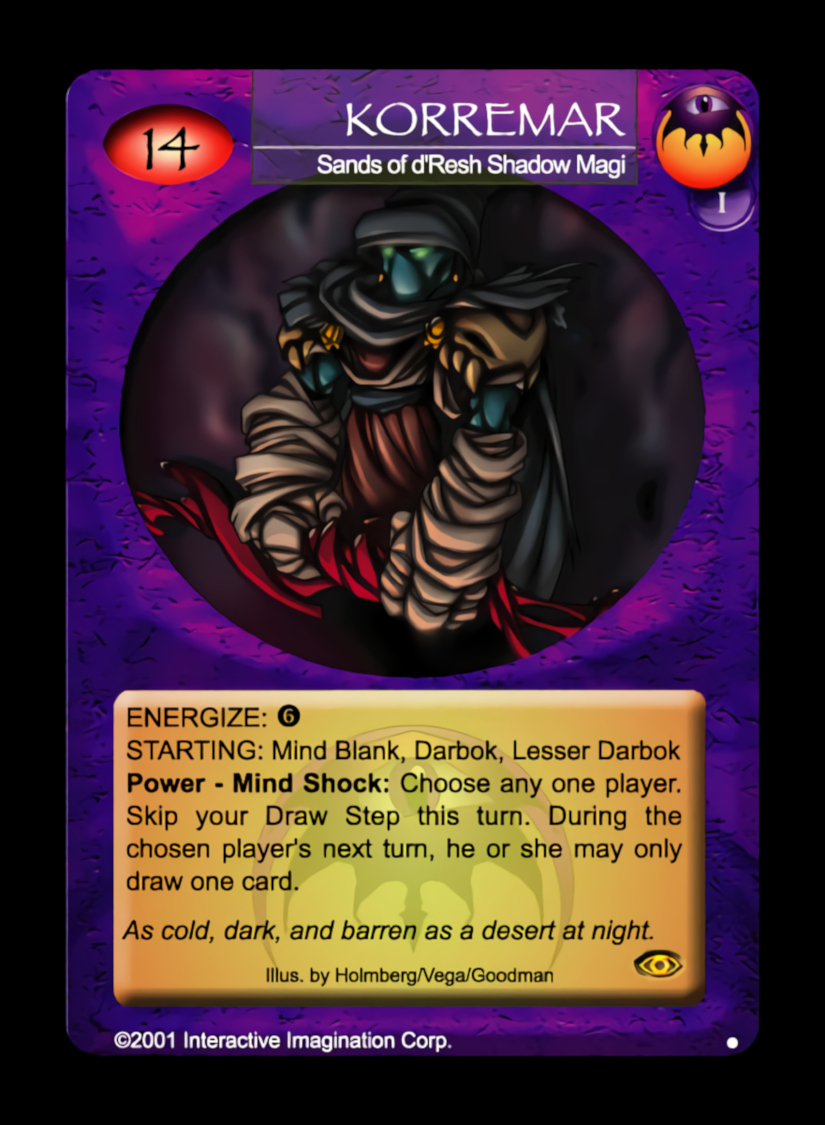
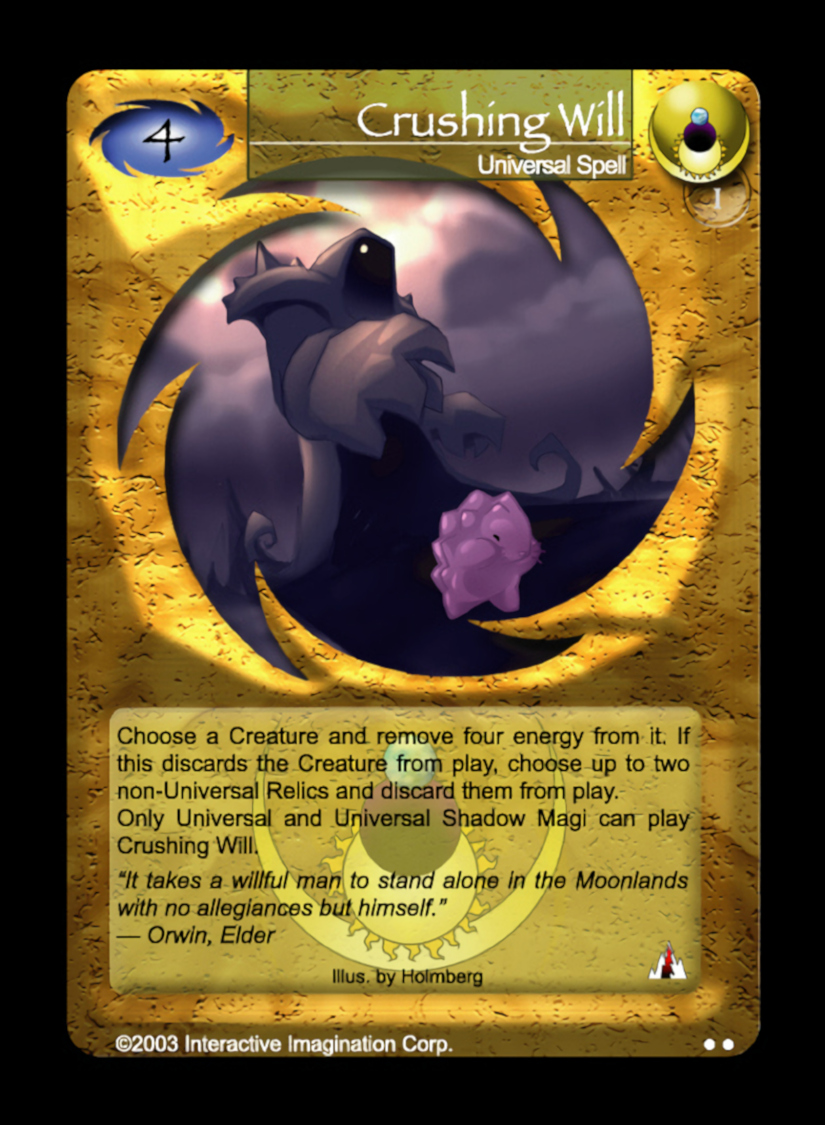
Light Side relates only tangentially at best to some major themes of d'Resh card design. d'Resh features two unique mechanics: Illusion - which makes you play certain creatures for half cost while preventing them from anchoring your Magi's life or letting them make progress anywhere but the field - and Recurring, allowing you to pick up some extra starting cards in the form of one previously-used Recurring card when your new Magi is revealed. With Light Side, named Illusions become dirt cheap, but that's about it. d'Resh is a highly aggressive region, and neither this nor Dark Side make that clear. In fact, Dark Side might only make you think that because Core has some pretty brutal cards. But even that is a huge stretch.
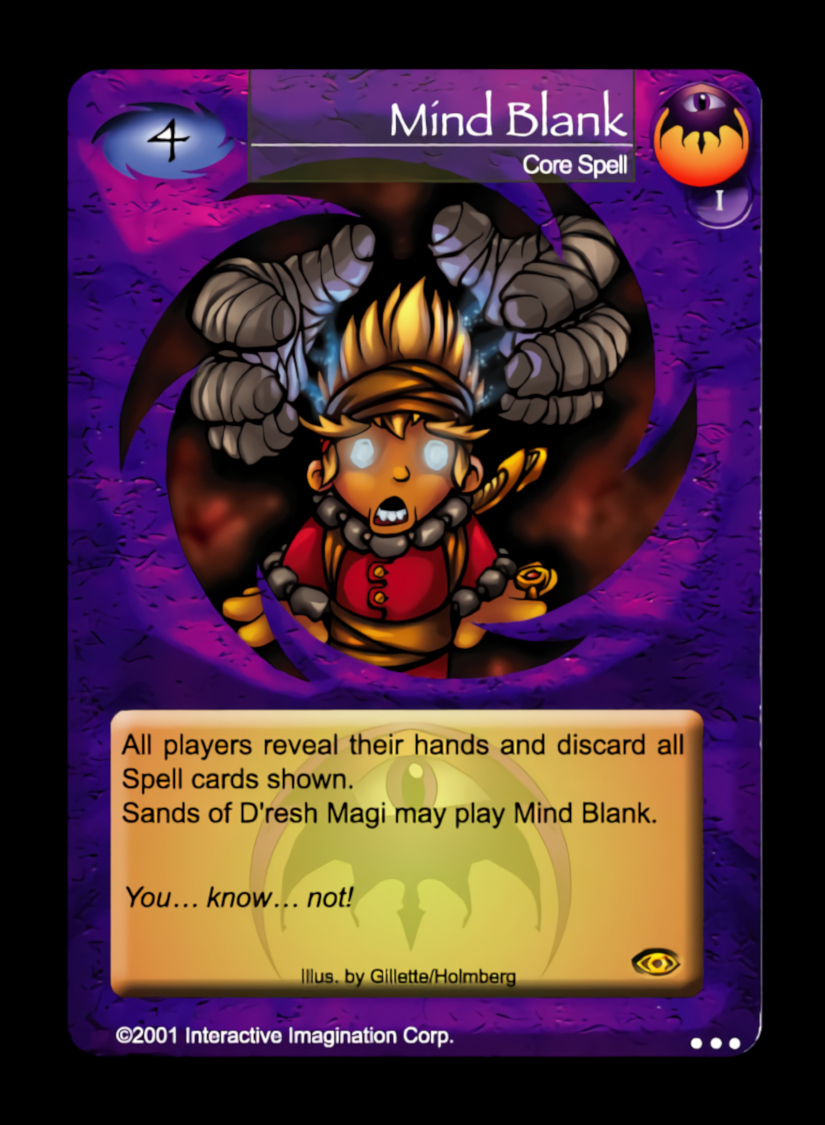
Instead, the "Core synergy" theme of Dark Side, something that is basically only seen here, refers to a story sequence, where presumed d'Resh Shadow Magi Korremar leads some of his Core allies into the desert and... I think just leaves them there to die, basically. It's been some years since I interacted with MND lore. With this, and the special rules text of Mind Blank, being the only mention of d'Resh for years, though, I suppose this serves as an effective misdirection... which might kinda miss the point a little.
Swamp Hyren is weird.
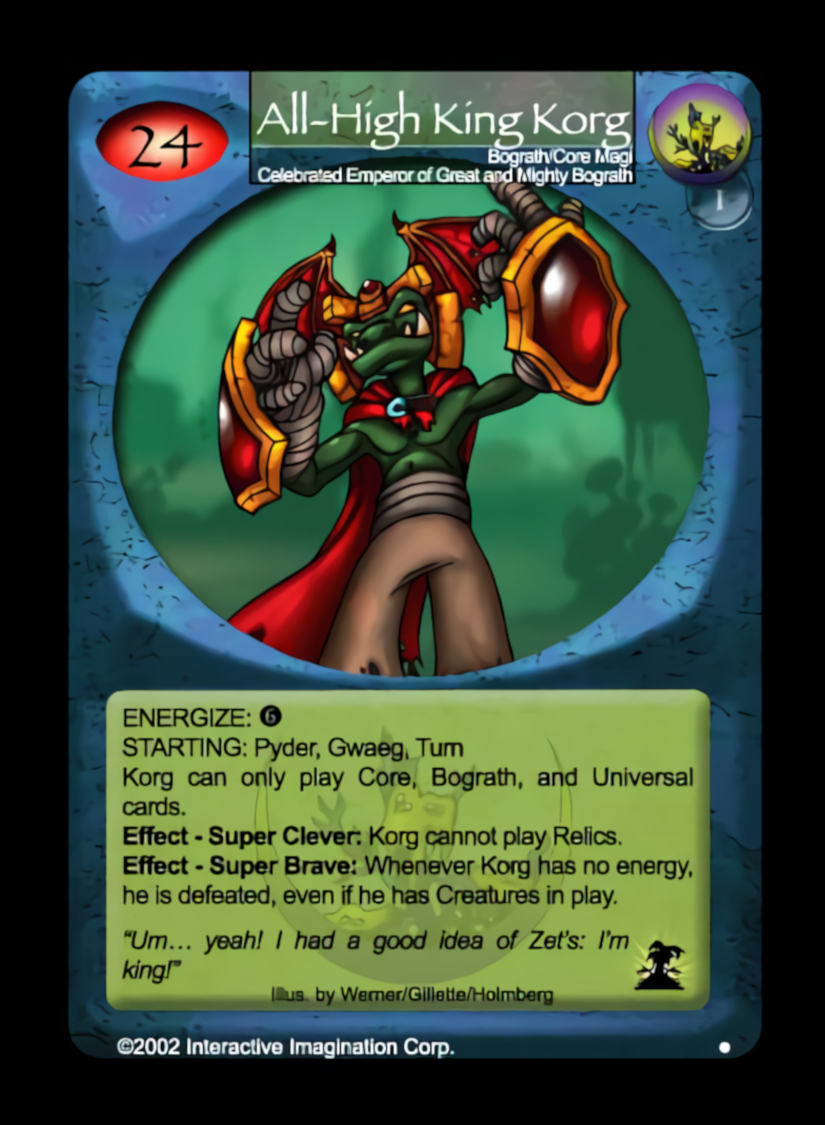
Swamp Hyren's focus on Bograth's identity through Nightmare Gate is a tad oblique. When it comes to the part of Bograth's identity tied very closely to Core (thanks to their being ruled by Core Magi Korg for a while), obviously this is about as front-and-center as you get. However, the other major aspect of Bograth's identity is playing weenies. As I said, this is kind of oblique. But cost reduction for a go-wide style in a game that has no tokens is extremely strong. Pity several of them cannot take advantage by virtue of having a cost of 1 or even 0, but there's still a very large amount of 2-drops that Nightmare Gate can make significantly more spammable, and Core can take advantage of this pretty well too.
The problem here is that, much like Sand Hyren, this is just more of a "goodstuff"-style card. It has a generically strong effect that is totally agnostic to your play style. As a result, as a preview for an upcoming region, it kind of sucks. Its tie-in to Core is a much stronger show of Bograthian identity, at least for a couple of sets' worth of story, making for a funny inversion of Sand Hyren. Also, needless to say, it has nothing to do with recurring Bograth effect Shifty (which protects your creatures from losing energy due to effects).
This is starting to end up as a list where the best cards are the oldest ones, and I hate that a little because it makes me sound like a whiny grognard. However, Ice Hyren indicates nothing about what Nar is like. It scores above Sand Hyren, however, because it ultimately actually nails some major aspects of Nar's regional identity. It's just that these are the parts that aren't expressed through unique regional mechanics. Nothing on Ice Hyren points to the Freeze status effect - primarily a taxation effect that many Nar cards can profit from. Nevertheless, at this point, we enter a new bracket, from cards that are just regional goodstuff, to cards that are regional goodstuff that do a good job poiinting to the region's identity in a real way.
Instead, these two effects look, respectively, at raw stats and one of Nar's greatest strategies. First of all, Shared Strength plays off of Nar Magi having poor starting energy but very good Energize rates. Your typical Nar Magi has something like 10 Starting Energy, 7 Energize, and one named Starting Card. This is so dead-on that I'm surprised the other ability doesn't count your starting cards and do something with that.
Ravage is an outlet for one of Nar's favorite strategies: relic control. Once you get over the slow start that your 9/7 with one starting card (meaning you're subject to RNG to get your strat on the road) engenders in you, you will want to play very few relics and punish your opponents for playing a lot of them. Amount of relics played tends to vary heavily, so this feels like a very specific counter to primarily Orothe decks, but it's an identity nevertheless. So Ice Hyren does a good job of reflecting what Nar is about, though in a way it does feel like just another "generic goodstuff" card.
This and the next one are on about the same level, and I couldn't really decide which one to put forward. I'll explain the tie-break later, in its own description.
Jungle Hyren, of course, does not really reveal that Dreamwarping is one of Paradwyn's major mechanics, and it has nothing to do with Jungle Stalker creatures or their mark-for-death "stalked" status effect. However, it does something very effectively that the other card does; it has an effect that's just a bigger version of an existing major mechanic of the region. Interestingly, it also can be used in an aggressive manner, against opposing creatures. You can use this to burn more energy off the Magi, or make them play a worse creature, depending on what your board is currently set up to deal with.
In all, Jungle Hyren doesn't reveal too much about Paradwyn, but it does point to its ability to create very flexible creatures on some level, and in particular underscores a unique play style. It makes Paradwyn look like a region that has something very innteresting going on; it makes you want to play Paradwyn. That's a pretty key part of these cards as previews.
Okay, first up, something is up with this scan. This does NOT look right. I've noticed that MND Workbench has a few card scans that are a little messed up, usually with typoes that weren't originally there, but this render just seems to be hashed together from other assets; the art does not look like that on the Awakening version of Rock Hyren, the expansion symbol is wrong, and it's using flavor text from a different release of the card.
With that out of the way, why did I choose this one over Jungle Hyren for second place? It's very simple: Kybar's Teeth has a much narrower identity as a region than Paradwyn and this covers it much better. KT is the "go tall" region - pile your resources into one big creature, and use spells that care about creature size and about you having the biggest creature. In fact, I think KT is the first region that uses the word "biggest" to describe the creature with the most energy. Starting with 11 energy and having a protective effect goes a long way to give you a good head start on the competition.
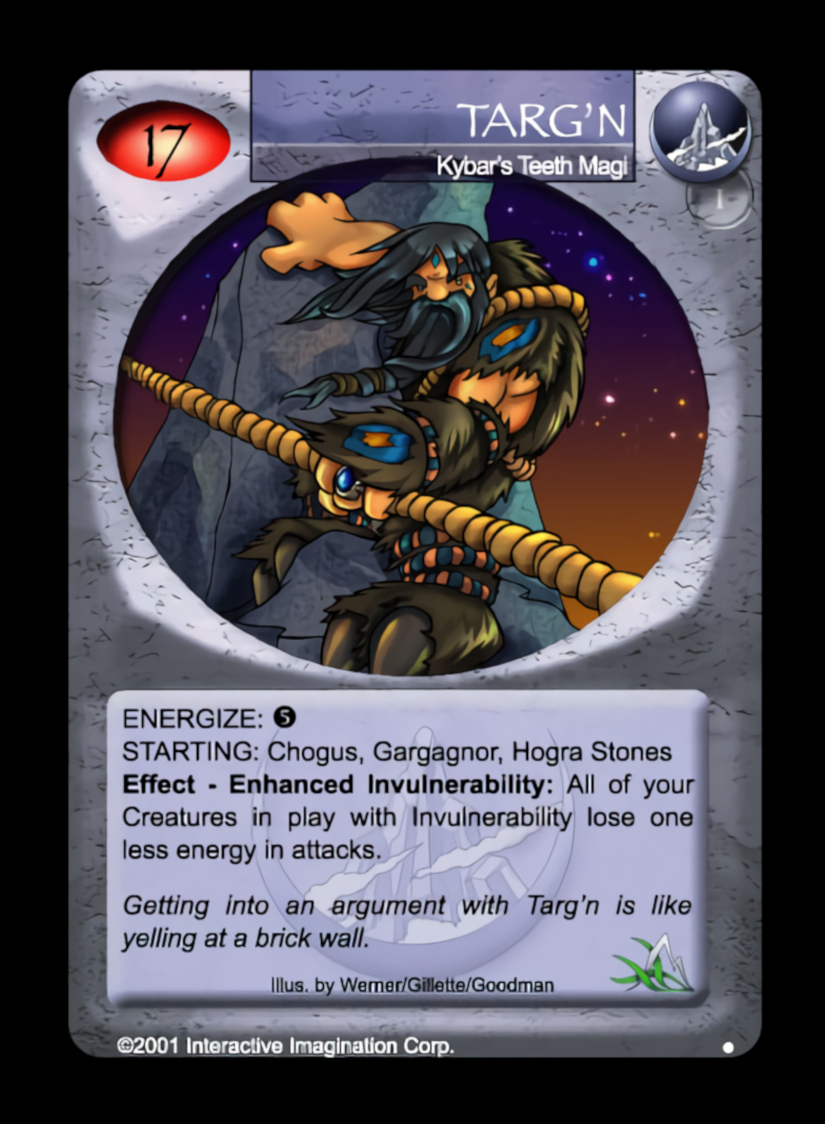
What's interesting, though, is that this version of Invulnerability is different from any other among KT creatures. This protects from noncombat damage, while other KT creatures' invuln explicitly protect from combat damage only. It also has a very upfront nonsynergy with Targ'n, who otherwise points to the idea of mechanics that boost invuln. This creature cannot take advantage.
Weave Hyren doesn't reveal very much, but is still one of the most in-your-face signposts out of the entire lot. If I'm being honest, this probably isn't a good choice, because Weave Hyren does not inherently preview either Weave's unique mechanic - Weave, which lets you move one energy between two creatures during combat - or its mechanical identity as being oriented around controlling the pace of combat. However, because Weave ties in very strongly to that, Wild Growth effectively and efficiently previews both of Weave's mechanics in one go. It's also just extremely good.
In short, I'm approaching this sideways. Weave Hyren actually might make you wonder what the deal is, since it's a very specific-looking effect that has a good payoff (boosting your whole board, a strong effect especially for a go-wide region, which Weave mostly is). You can somewhat discern from many other of the preview Hyrens. You will sometimes be led astray. But Weave Hyren doesn't reveal much until the next set came out and showed just how effective it was from this perspective.
Again, this list is about quality as previews, and this part is an important aspect of that; the part where everything else is revealed. The moment where it all adds up and you go "oh, that's pretty cool." Weave Hyren may not do the most by itself, but as part of a whole, it's extremely strong.
Most of these aren't drastically revealing of what the new regions are like, and serve more as reveals for the regions themselves. This probably helps account for why there's a general breakdown in terms of the quality of such around Nightmare's Dawn, where you had cards with the other region borders already, and a turn more toward these being general-purpose goodstuff cards. Still, this was a pretty fun little thing back in the 2000s, when rumors about things could still be fun. I think all the region names were leaked at some point, so that did mess with how much hype there could be for the new regions period, but I remember really waiting for when the Nar cards started to show up and it felt like it took forever.
Anyway, I'm still skeptical of MND being fully "back," even though I'm hopeful. So this is soon to be a fun little relic of the past that I think nobody will care too much about. Oh well. It was fun to get my thoughts down, as otherwise it might eat at me for a while.
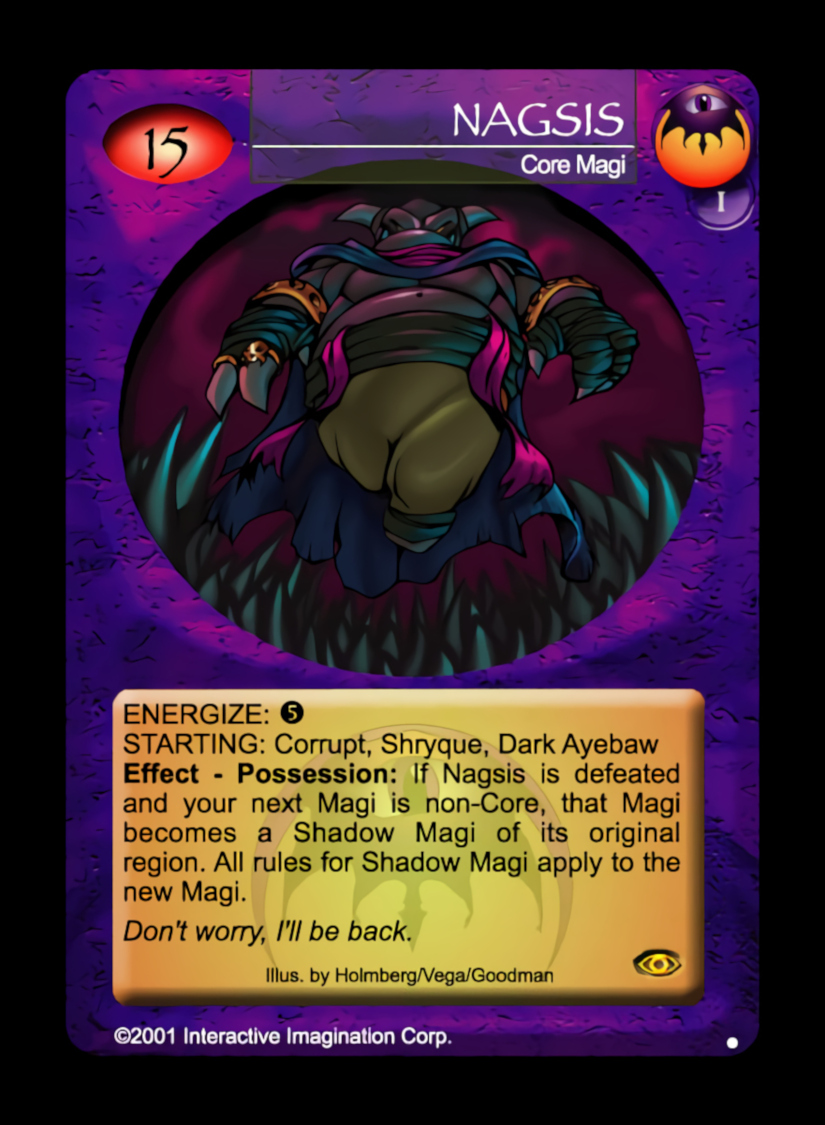
1. ↑ For each region in the game, you can typically play a non-Universal spell or creature of a different region from that of your active Magi for a regional penalty of one extra energy on the cost. You generally cannot play non-Universal relics of a different region. Core is different. Unless you have very specific other cards in play that allow you to, if your Magi is not Core, you cannot play Core cards that do not have any further rules text stating otherwise, and if your Magi is Core, you can't play anything that's not Core (or Universal). Certain Core Magi are "[region] Shadow Magi" who can play... Core and Universal cards, plus a specific subset of cards that say they can be played by Shadow Magi of that region (who must still pay a regional penalty unless the card says otherwise!). Which also means that, without the support of other cards, any card from the base set is off limits to you, with the exception of Universal cards. Yeah... Early on, a major advantage of Core tended to be sheer, raw power, especially if you were a control player. (And no, they sure the hell did not add Shadow Magi for all 11 other regions (nor a Universal Shadow Magi, a concept attested to in the rules text of one card and technically possible with the effect of Nagsis. Paradwyn and Nar never got one - nor did Bograth, but that had other interactions with Core, so perhaps it's fine.)
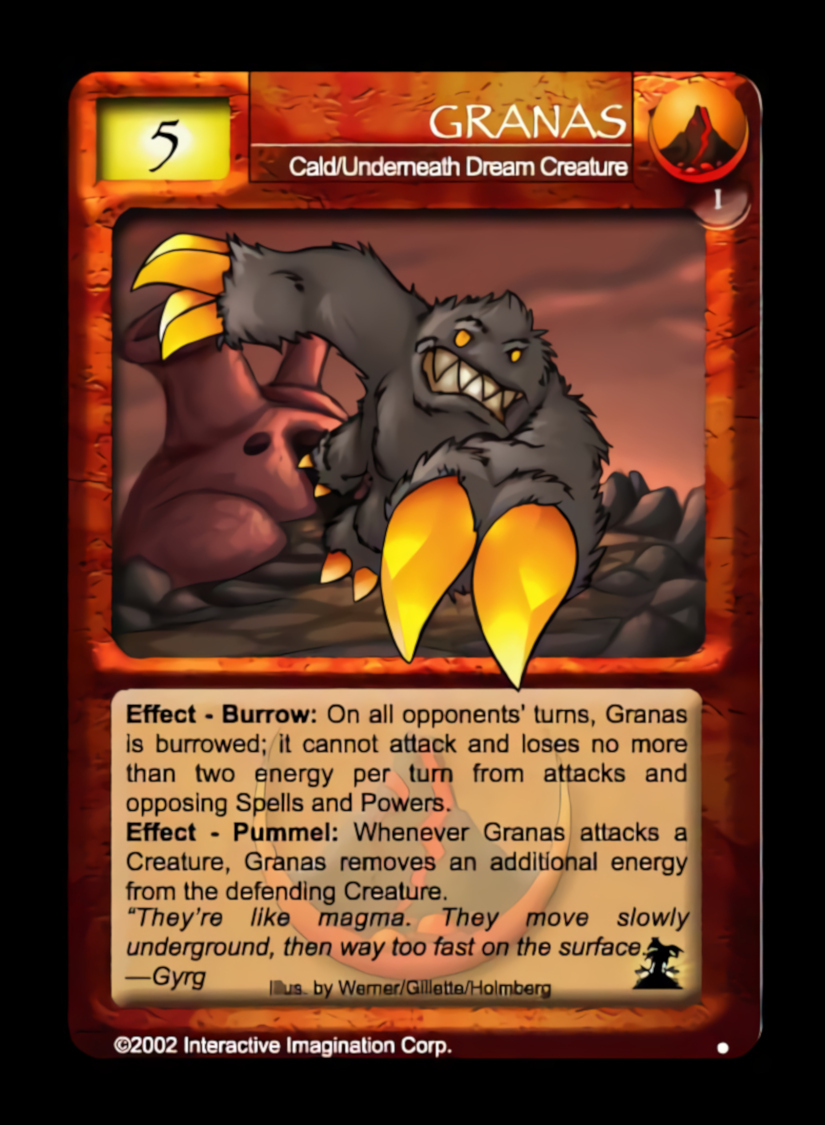
2. ↑ Interactive Imagination was actually kind of smart in how they handled this in a way, with Dream's End vaguely introducing, and Nightmare's Dawn going all-in on, dual-region cards. This also allowed ND to effectively include more than just the preview card for the final two regions, giving Voice of the Storms a major head start in attempting to equilibrate the twelve regions. This also causes some other headaches from a design perspective, where you have to either design inside the shared domain of the two regions (i.e. the kind of design hybrid cards aim for in Magic), or allow some dilution of regional identity, such as with Granas adding the "Burrow" status from Underneath to Cald with no added cost. This ends up effectively just being a fairly generic defense buff, but because it is a fairly specific one that is interacted with by the rest of the game, it messes with things a lot.